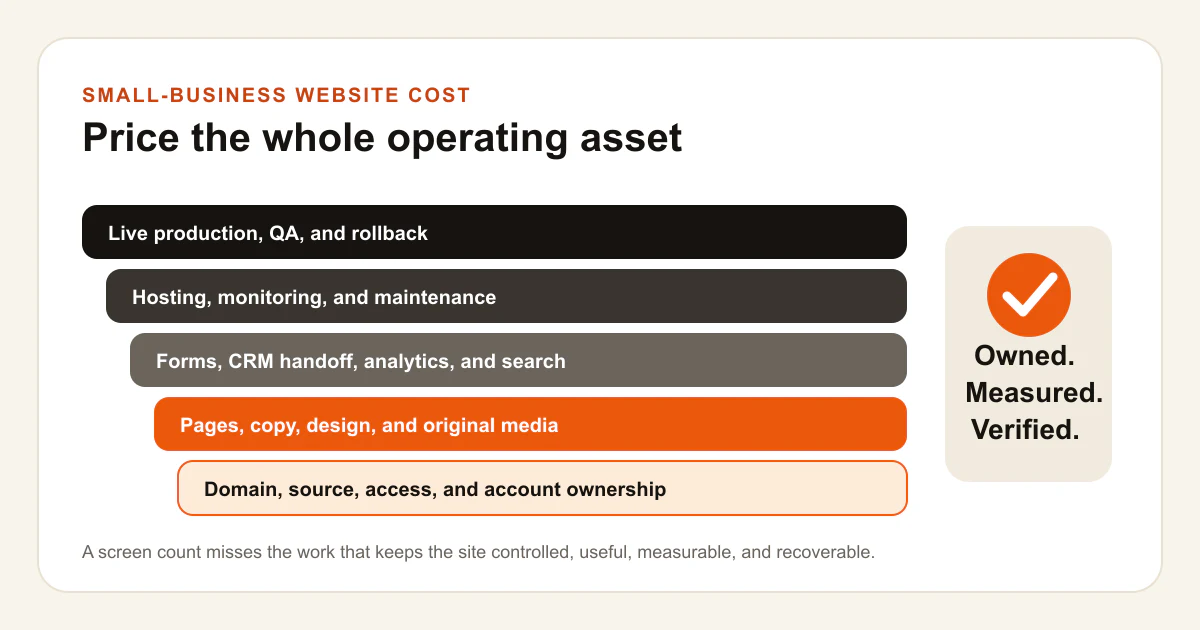
What does a small-business website cost at BlackTiger Growth?
BlackTiger pricing starts at $299 per month, plus a $199 setup fee. The exact scope can change after the call, and the starting price should not be read as a universal quote for every website.
A focused site with a clear offer and a few page owners takes less work than a multi-location build with several services, custom integrations, original media, migration, and a new measurement system.
Which parts of a website change the cost?
The cost follows the amount of distinct work, not the raw page count alone. Ten repeated pages can be easier than three pages that need original research, custom workflows, and careful proof.
| Part | Lower scope | Higher scope |
|---|---|---|
| Page architecture | One offer, one market, a few distinct decisions | Several services, locations, audiences, or regulated decisions |
| Copy and proof | Approved facts and media are ready | Research, interviews, source recovery, or proof permission is needed |
| Design and build | Shared components and standard content patterns | Custom interactions, data views, tools, or account experiences |
| Lead handoff | One tested form and notification | CRM routing, scheduling, qualification, attribution, and automation |
| Migration | New site with no valuable URLs to preserve | Existing rankings, redirects, content, analytics, and live integrations |
Responsive work is part of the build, not an optional phone add-on. Google also tells developers to make sites secure, fast, accessible, and usable across devices.
What should a small business own after the build?
The business should know who controls the domain, DNS, source, deployment, analytics, Search Console, original content, media, forms, CRM routes, and key service accounts.
- Domain and DNS: the legal business or named owner controls the registrar and records.
- Source and deployment: access does not disappear when an agency relationship ends.
- Content and media: approved copy and original assets have a clear owner and usable files.
- Measurement: analytics and search properties belong to the business with the right agency access.
- Lead delivery: forms, calls, notifications, and CRM routes are documented and tested.
- Production record: the business can identify what is live, what changed, and how to roll back.
Ownership does not mean the owner must manage every technical detail. It means the asset remains visible, transferable, and recoverable.
Which website costs continue after launch?
Hosting, domains, third-party software, monitoring, maintenance, content changes, measurement, and support can continue after launch. The quote should name which costs are included and which vendors bill separately.
A working launch is the beginning of the live evidence, not the end of the website. Search demand changes. Offers change. Forms and integrations can fail. A useful maintenance scope checks the parts that affect customers and lead delivery.
Do not accept a vague maintenance line. Ask what is monitored, how often it is checked, what response is included, and what counts as new development.
What should a website handoff include?
A handoff should leave the business able to operate, verify, and transfer the site. It is more than sending a password or a folder of files.
- List every account, owner, role, domain, deployment, and billing boundary.
- Record the canonical URLs, redirects, forms, analytics events, and CRM destinations.
- Provide original assets, approved copy, source access, and deployment instructions.
- Verify the real domain on phones and computers after any final change.
- Name the rollback path and the person responsible for future changes.
See how BlackTiger builds small-business websites, review the starting price, and read how responsibility and verification are handled.
Common questions
Questions about Small-Business Website Cost and Ownership
Is $299 the price of every BlackTiger website?
No. It is the starting monthly price for the BlackTiger engagement. The final website scope and price depend on the pages, content, integrations, migration, and ongoing work required.
Should the business own the domain?
Yes. The domain should stay under the business or a named owner with documented access. An agency can manage DNS without owning the business's address on the web.
Are hosting and software included in every quote?
Not automatically. The scope should state which vendor costs are included, which are billed separately, who owns each account, and what happens when the engagement ends.
Does launch prove the website works?
No. Launch proves a deployment happened. The real domain still needs page, mobile, image, link, form, metadata, schema, sitemap, and lead-delivery checks.
Sources and limits
Primary guidance and first-party boundaries.
- Google developer search guideGoogle's current baseline for secure, fast, accessible, device-ready, crawlable sites.
- Google SEO Starter GuideGoogle's guidance on organization, descriptive URLs, crawl access, links, and user-first content.
- BlackTiger pricingThe public starting price, setup fee, and exact-scope boundary used in this guide.
Price the whole website, not just the screens.
Tell us what the site must explain, connect, and measure. We will map the scope, the ownership, and the live checks before the build.