When does a website need a redesign?
A redesign is justified when the site's structure prevents it from doing the job. The problem is deeper than a headline, button, or color.
- The offer has changed and the current pages no longer match what the business sells.
- Important services, audiences, or locations have no clear page owner.
- The site is hard to use on phones or cannot meet basic accessibility and performance needs.
- The business cannot control the domain, source, deployment, content, or measurement stack.
- Forms, CRM handoff, analytics, and search setup need a new foundation.
- The platform blocks ordinary updates or creates more risk than a rebuild removes.
When is conversion optimization the better choice?
Conversion optimization is the better choice when the site works, the offer is understandable, and evidence points to a specific obstacle between the right visit and the next action.
Examples include a confusing form, a weak service-page CTA, missing proof near a decision, a mismatch between a search and its landing page, or a clear phone-only problem. These can be changed and measured without replacing the whole site.
Low traffic changes the method. If the site lacks enough qualified visits for a reliable split test, use effect checks, calls, forms, customer questions, and careful before-and-after observation. Do not turn a few clicks into a confident percentage.
How do redesign and conversion optimization compare?
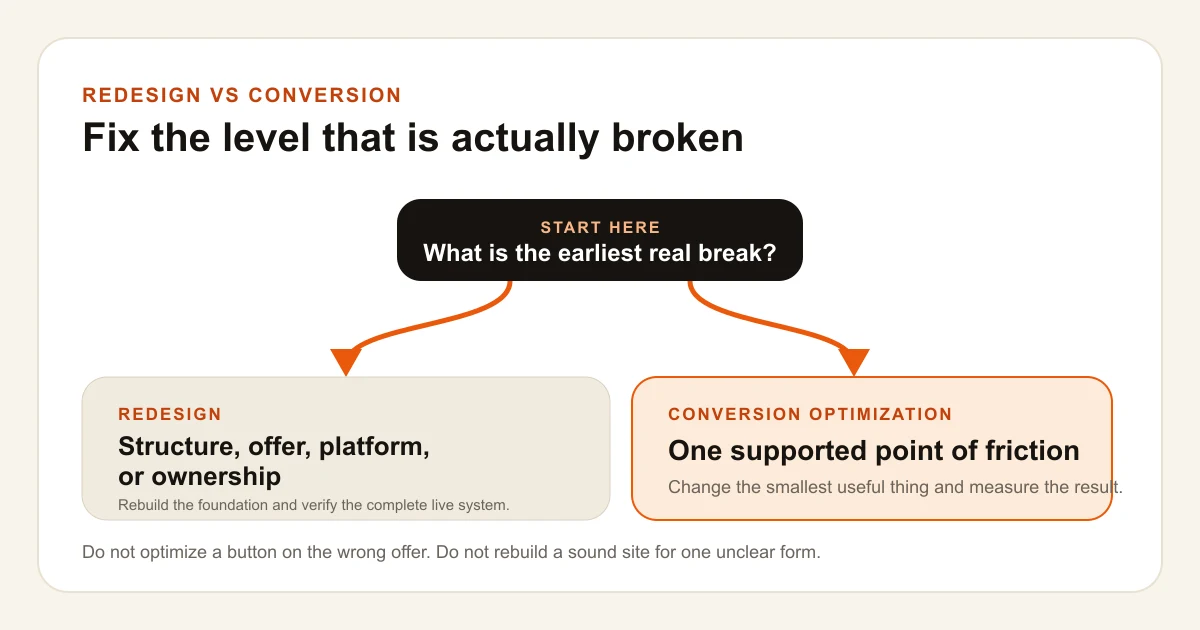
The choice depends on the level of the break. Use redesign for a broken system and conversion work for a supported point of friction.
| Question | Redesign | Conversion optimization |
|---|---|---|
| What is broken? | Offer, architecture, platform, ownership, or core lead path | A specific decision, page, form, message, or interaction |
| How broad is the change? | Several shared components or page owners | One controlled change or a small connected set |
| What evidence is needed? | Structural audit, business change, technical risk, and ownership gaps | Behavior, search intent, calls, forms, customer language, and a baseline |
| What is the rollback? | Prior deployment, redirects, content record, and migration plan | Restore the prior variant or page state |
| What proves completion? | Live site, route, device, form, search, and ownership checks | Live effect check first, then the dated measurement result |
What evidence should you collect before choosing?
Start with whether the site can be used and measured. A broken form, missing event, slow page, or wrong mobile layout can create the same symptom as weak copy.
- Confirm the right visitors reach the right page.
- Test the page, navigation, form, call action, and lead handoff on real devices.
- Read the offer and next step without internal business context.
- Compare Search Console discovery data with Analytics behavior and actual lead records.
- Find the earliest point where a qualified visitor is blocked or lost.
- Choose the smallest change that can repair that level of the problem.
Search Console and Analytics use different systems and metrics. Google says they will not match exactly. Treat that difference as a measurement fact, not automatic proof that one system is broken.
Can redesign and conversion optimization happen in sequence?
Yes. A redesign can establish the right page structure, measurement, mobile experience, and lead handoff. Conversion work can then improve specific decisions after the new baseline is live.
The order matters. Optimizing a button on a page with the wrong offer wastes the test. Rebuilding a sound site because one form is unclear wastes the redesign.
See BlackTiger's website design work, the conversion diagnostic, and the evidence standard used after a change.
Common questions
Questions about Website Redesign vs. Conversion Optimization
Is an old website automatically due for a redesign?
No. Age alone does not prove the site is broken. Test the offer, pages, mobile use, performance, ownership, forms, and measurement before choosing the scope.
Can conversion optimization work with low traffic?
Yes, but the method must fit the sample. Use functional checks, customer evidence, calls, forms, and careful before-and-after observation instead of claiming a small sample proves a percentage.
Should a redesign preserve existing URLs?
Preserve valuable URLs whenever possible. If a URL must change, map and test the redirect, update internal links, and verify the live result before calling the migration complete.
Does a new design guarantee more leads?
No. A redesign can improve the foundation and remove clear obstacles. Lead results still depend on traffic quality, the offer, proof, follow-up, market demand, and the measured live outcome.
Sources and limits
Primary guidance and first-party boundaries.
- Google Search Console and Analytics guideGoogle's current explanation of the two measurement systems, their distinct roles, and normal discrepancies.
- Google developer search guideThe technical baseline for secure, fast, accessible, device-ready pages.
- BlackTiger results standardThe current public boundary between a technical action and an observed business result.
Fix the right level of the website.
Tell us what the site should help customers do. We will check whether the structure needs a rebuild or one supported obstacle needs a smaller change.