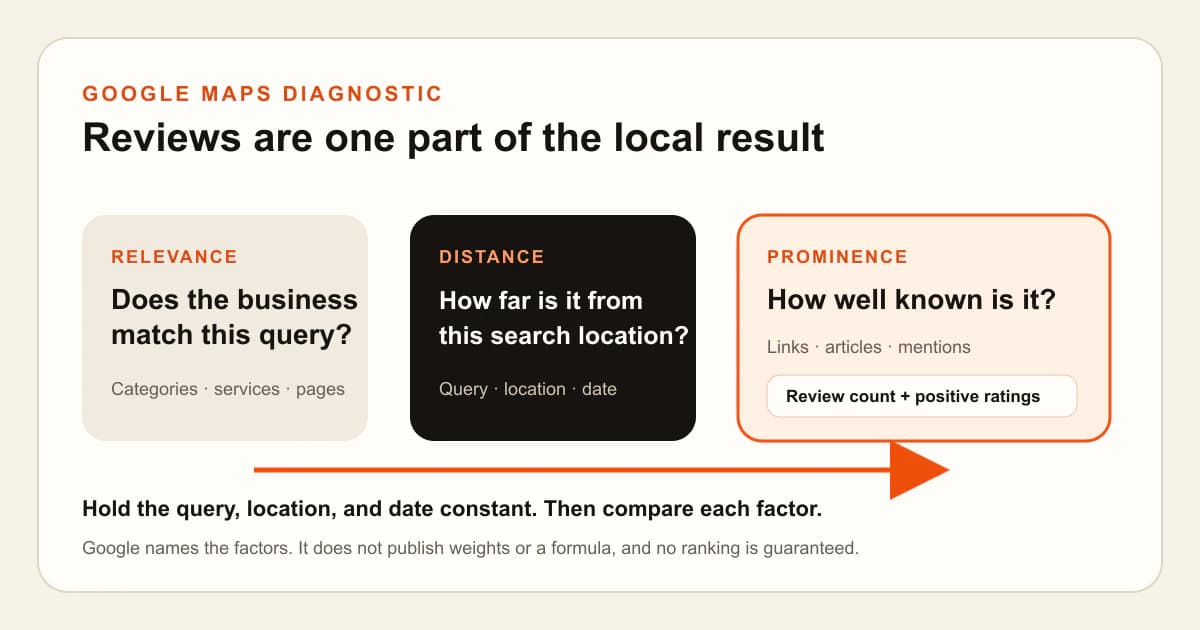
What do review count and rating tell Google?
Google says review count and positive ratings can help a business's local ranking. That makes reviews part of the picture, not the whole score.
Reviews can support prominence and help a customer choose. A larger count does not reveal whether the profile matches the query, whether the business is closer to the searcher, or what other prominence signals Google sees.
How can relevance put a lower-review competitor above you?
Relevance is how well a local business profile matches what the customer is searching for. The exact service, category, business information, and supporting website content can change that match.
A business with fewer reviews may be a clearer match for one query. That does not mean it is more relevant for every query. Compare the exact phrase, the primary and secondary categories, the services, and the page Google can connect to the business.
Do not infer the cause from category names alone. The result needs the full profile, website, and query context.
How can distance change which competitor ranks higher?
Distance is how far each potential result is from the location used for the search. Google can estimate the location when the customer does not include one in the query.
The same two businesses can change order when the search happens from another neighborhood. Review counts stay the same while the distance relationship changes.
This is why a screenshot without the search location is weak evidence. Record the query, the location used for the search, and the date before comparing results.
What belongs to prominence besides reviews?
Google describes prominence as how well known a business is. It says information from across the web, including links and articles, can contribute. Review count and rating can also factor into local ranking.
A competitor with fewer reviews may have stronger or different prominence evidence elsewhere. The visible review total does not expose every link, mention, article, business-history signal, or offline prominence cue Google may use.
Google does not publish a factor weight or a formula that turns these inputs into a guaranteed position. A diagnosis should stay with observable evidence.
How should you compare two Google Maps results?
Hold the query, location, and date constant. Then inspect each layer separately before deciding what work is justified.
- Query: record the exact service and place language used.
- Location: record where the search was made or the location it represented.
- Relevance: compare categories, services, profile facts, and the supporting website page.
- Distance: compare each business with the search location, not only with the center of a city.
- Prominence: compare reviews, links, mentions, articles, listings, and real-world visibility without assuming one signal decides the result.
- Action: fix the first supported gap. Do not change categories, pages, or review systems because one screenshot felt unfair.
Without the exact query, search location, date, profiles, and website evidence, this guide cannot diagnose why a named business ranks higher. Google does not publish factor weights, and no ranking is guaranteed.
Read Google's local ranking guidance, then see how BlackTiger checks local-search gaps or book a free call.
Common questions
Questions about Why a Competitor With Fewer Reviews Can Rank Higher on Google Maps
Do Google reviews affect local rankings?
Yes. Google says review count and positive ratings can help local ranking. Reviews sit inside a larger system that also includes relevance, distance, and broader prominence.
Why does the order change when I search from another place?
Distance changes with the search location. The same business can be close to one searcher and farther from another, so the result order can change even when the profiles do not.
Can I calculate Google's local ranking weights?
No public formula exists. Google names relevance, distance, and prominence, but it does not publish factor weights. Treat any precise weighting claim as unsupported unless Google documents it.
Should I get more reviews if a competitor ranks higher?
Reviews may still be useful for customers and prominence, but first identify the supported gap. More reviews will not fix a relevance or distance problem by themselves.
Sources and limits
Primary guidance and first-party boundaries.
- Google local ranking guidanceGoogle's current explanation of relevance, distance, prominence, reviews, links, and the no-pay-for-rank boundary.
- Local SEO discussion about a competitor with fewer reviewsCommunity language showing the recurring counterfactual. It cannot diagnose either business.
- Local SEO discussion about a stuck profileA second community receipt for the same ranking concern. Technical truth comes from Google's guidance, not the thread.
Check the factor you can actually support.
Tell us the query, market, and competitors. We will separate relevance, distance, and prominence before recommending a change.