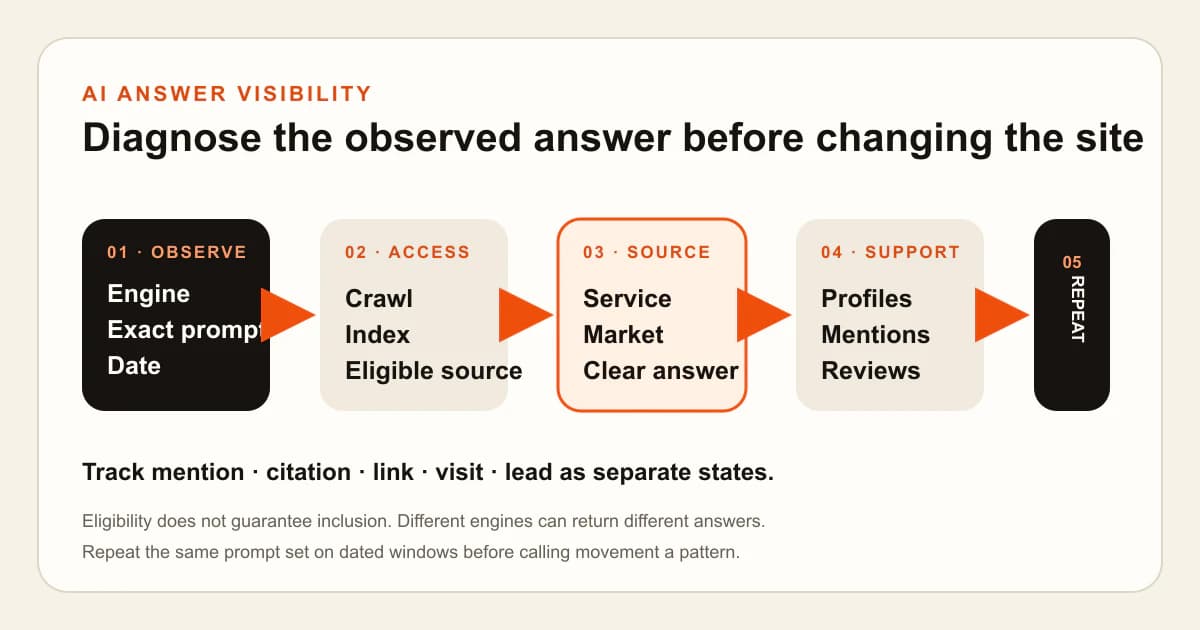
What should you record before diagnosing an AI answer?
Start with the observed answer, not a general impression that the business is missing. Record enough context to repeat the check.
| Record | Why it matters |
|---|---|
| Engine and surface | Google AI Overviews, AI Mode, ChatGPT search, Gemini, and other tools do not use one identical system. |
| Exact prompt or query | A small wording change can ask for a different service, place, comparison, or recommendation. |
| Date and context | Answers and available sources can change over time and may vary with location or account context. |
| Mention, citation, and link | A business can be named without a source link, or a page can be cited without the brand becoming the main answer. |
| Linked URL | The cited page shows which source the system chose, not merely which brand appeared. |
Can the AI search system access and use the page?
Check the rule for the exact surface. Google says a page must be indexed and eligible to appear in Search with a snippet before it can be a supporting link in AI Overviews or AI Mode. Meeting the requirements does not guarantee that Google will crawl, index, or serve it.
OpenAI says public websites can appear in ChatGPT search and advises publishers not to block OAI-SearchBot when they want content included in summaries, citations, and links. Search access is separate from a guarantee that a page will be chosen.
Inspect robots controls, index status, canonical ownership, snippet controls, server responses, and whether the important answer exists in text. A source that cannot be reached or understood cannot support a reliable diagnosis.
Does the website state the business answer clearly?
The source should say what the business does, who it serves, where it works, and which facts support the answer. Put each meaningful topic on one canonical owner page and route related pages to it.
A page that says only that the company offers great service gives an answer system little to work with. A useful source names the service, decision, constraints, process, and evidence in plain text.
Check whether the title, opening answer, headings, body, internal links, and visible business facts agree. Fix contradictions before adding more pages.
Is the business identity supported by other real sources?
Outside sources show whether the business's services, market, people, and reputation are corroborated beyond its own website. Those sources may include a current Business Profile, trusted directories, relevant publications, public profiles, and customer reviews.
Corroboration must be real. Do not create fake mentions, composite ratings, or pages that pretend to be independent customer proof. Public customer proof belongs to the business's canonical proof owner and the original platform.
Reviews can support the existence and reputation of a business. They are not an inclusion switch and they do not guarantee that an answer will mention or link to the company.
How should AI search visibility be measured over time?
Use a fixed set of prompts and record each engine separately. Repeat the checks on dated windows instead of treating one answer as a permanent result.
- Record the engine, exact prompt, date, and relevant location or account context.
- Mark whether the business was mentioned, cited, linked, and described correctly.
- Record the linked URL and the other sources used in the answer.
- Track visits from the source where referral data is available.
- Keep visits, inquiries, qualified leads, sales, and revenue as separate states.
- Compare the next observation with the same prompt set before drawing a conclusion.
This diagnostic cannot guarantee a mention, citation, link, recommendation, or permanent placement. Google, ChatGPT, and Gemini use different systems and may return different answers.
Read Google's current AI feature guidance and OpenAI's publisher guidance. Then see how BlackTiger checks AI visibility or book a free call.
Common questions
Questions about Why Your Business Does Not Appear in AI Search Answers
Does an indexed page have to appear in an AI answer?
No. Google says eligibility does not guarantee crawling, indexing, or serving. OpenAI also describes search access as a discovery condition, not a promise that ChatGPT will choose the page.
Why can the same prompt return a different answer later?
The engine, model, sources, index, prompt context, and date can change. Record the exact setup and repeat a fixed prompt set before treating movement as a pattern.
Is an AI mention the same as a citation?
No. A mention names the business. A citation identifies a supporting source. A link can send a visit. A visit, lead, and sale are later and separate outcomes.
Do customer reviews guarantee AI visibility?
No. Reviews can corroborate a business and help a customer judge it, but they are not an inclusion switch. The source, access, identity, and answer still need to be clear.
Sources and limits
Primary guidance and first-party boundaries.
- Google guidance for AI features and websitesGoogle's current requirements, eligibility limits, source controls, and measurement guidance for AI Overviews and AI Mode.
- OpenAI publishers and developers FAQOpenAI's current guidance on public-site eligibility, OAI-SearchBot access, citations, links, and referral tracking.
- Local SEO discussion about strong rankings but weak ChatGPT visibilityCommunity language showing the recurring missing-answer concern. It cannot establish the cause.
- Local SEO discussion about how AI systems find local businessesA second community receipt for the question. Technical boundaries come from Google and OpenAI.
Diagnose the answer before changing the site.
Tell us the engine, prompt, and market. We will check access, source clarity, corroboration, and the measurement needed for a useful next decision.