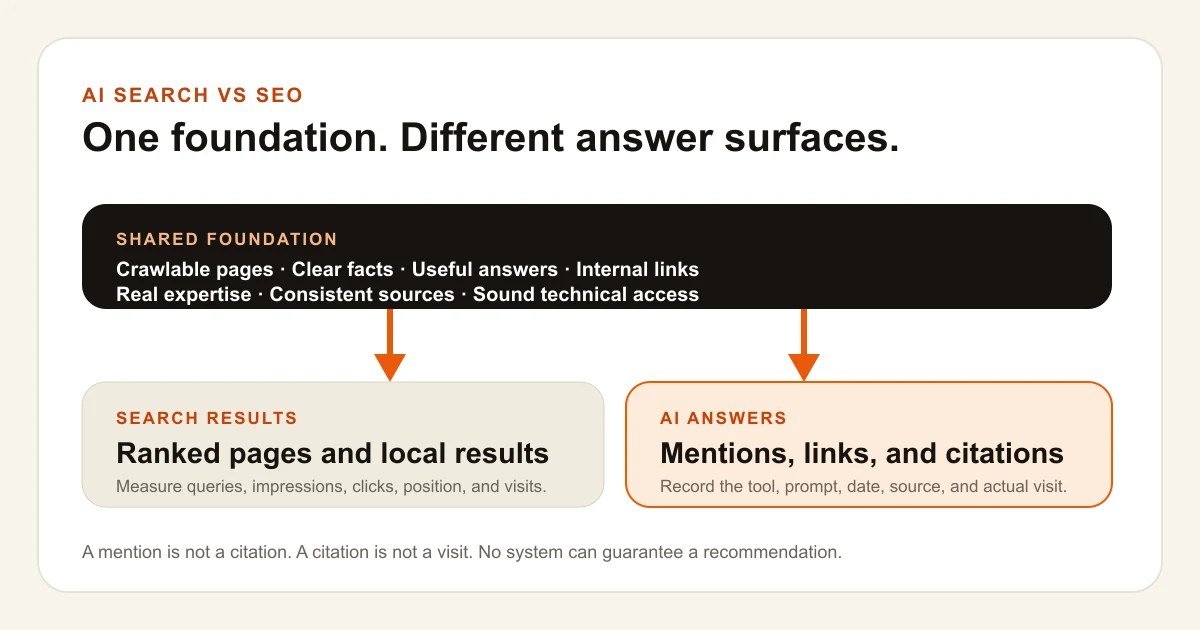
What do AI search optimization and SEO share?
They share the same basic need: a business must publish clear, useful, crawlable information that matches what people want to know. Google says its normal SEO guidance still applies to AI Overviews and AI Mode.
Both depend on sound technical access, useful page structure, accurate business facts, relevant internal links, original expertise, and sources people can trust. Structured data can clarify the page, but it must match the visible content.
Where does AI search work differ from traditional SEO?
The difference appears in the answer surface and the checks around it. A traditional search result usually shows a ranked list. An AI answer can combine several sources into one response, change with the prompt, and cite a page without sending a click.
| Area | Traditional SEO | AI search optimization |
|---|---|---|
| Primary surface | Search result, local result, image, video, or other search feature | Generated answer, supporting link, citation, or recommendation surface |
| Core content | Pages that satisfy a search intent and help the visitor choose | The same pages, with facts and passages clear enough to interpret in an answer |
| Discovery controls | Search-engine crawling, indexing, canonical, and snippet controls | Those controls plus each answer provider's documented search crawler and policies |
| Variation | Results vary by query, location, device, and time | Answers also vary by model, prompt wording, conversation, sources, and date |
OpenAI documents OAI-SearchBot separately from GPTBot. One supports search visibility and the other relates to model training controls. That is one example of why crawler names and effects should be checked instead of guessed.
What should you measure for SEO and AI search?
Measure each surface in its own terms, then connect both to the same business outcomes. Search Console remains the source for Google Search performance. Analytics measures what people do on the site.
- SEO visibility: indexed pages, queries, impressions, clicks, position, and local map coverage where relevant.
- AI visibility: answer tool, exact prompt, date, mention, cited source, linked URL, and whether the answer described the business correctly.
- On-site behavior: landing page, engaged visits, calls, forms, and the actions that matter on that page.
- Business result: qualified lead, appointment, sale, revenue, and lead quality.
A mention is not a citation. A citation is not a visit. A visit is not a lead. Keep those states separate.
If the business is missing from a specific answer, record the engine, prompt, and date first. The AI answer visibility diagnostic owns that next check.
Does a small business need both SEO and AI search optimization?
Most businesses need one strong search foundation and an additional AI-answer check, not two disconnected programs. The website, business profiles, reviews, and outside sources should tell the same true story.
Local businesses still need accurate profiles and local pages because customers use Search and Maps. They also benefit when answer tools can find clear service, location, price, comparison, and expertise information.
Start with the weakest foundation. If pages cannot be crawled or the offer is unclear, fix that first. If the foundation is sound, examine how major answer systems interpret the business and which useful questions remain unanswered.
What can no SEO or AI-search provider guarantee?
No provider can guarantee a number-one search ranking, inclusion in an AI answer, a citation, or a permanent recommendation. Google says meeting its requirements does not guarantee crawling, indexing, or serving.
The defensible job is to improve the source, keep access open where the business wants visibility, verify what each system actually shows, and measure whether the right people reach the business.
See BlackTiger's AI search work, the local SEO foundation, and who owns the judgment behind the system.
Common questions
Questions about AI Search Optimization vs. Traditional SEO
Is AI search optimization replacing SEO?
No. Google says normal SEO best practices remain relevant for AI features. AI-answer work adds provider-specific interpretation and measurement checks to the same search foundation.
Does a business need an llms.txt file to appear in Google AI features?
No. Google says there is no new machine-readable file or special schema required for AI Overviews or AI Mode. The page must be indexed and eligible for a snippet.
Can schema guarantee an AI citation?
No. Structured data can help a system understand page facts when it matches the visible content. It cannot guarantee a citation, ranking, or recommendation.
How often should AI visibility be checked?
Use a fixed prompt set and dated checks, then compare changes over time. One answer is only an observation from that tool, prompt, date, and context.
Sources and limits
Primary guidance and first-party boundaries.
- Google AI features and your websiteGoogle's current statement that SEO fundamentals remain relevant and no special AI markup is required.
- Google SEO Starter GuideThe shared technical, content, discovery, and assessment foundation.
- OpenAI crawler documentationOpenAI's current definitions for OAI-SearchBot, GPTBot, and ChatGPT-User controls.
Build one source that search and answer tools can understand.
Tell us what customers ask and where your business should appear. We will check the foundation, the answer surfaces, and the proof limits.