What job does positioning do for a local service business?
Positioning helps a buyer understand why this business fits the job better than the other credible options. It is not a slogan and it is not a claim that the business is best for everyone.
The work starts when several businesses describe themselves with the same promises. If every company says quality, service, and experience, the buyer still has no useful reason to choose. A stronger position names a difference the business actually delivers.
Which evidence should shape the position?
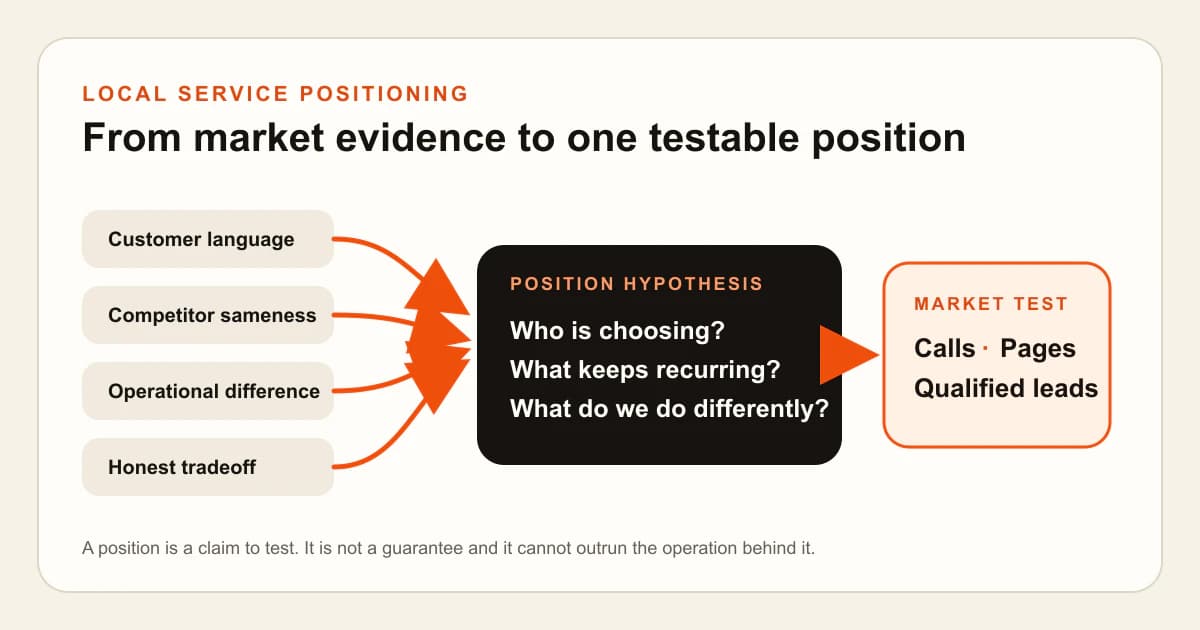
Use evidence from the buyer, the market, and the operation. Search language and community questions show how people describe the problem. Competitor pages show which promises have become interchangeable. The business supplies the operational fact.
| Evidence | Question to answer | What it cannot prove |
|---|---|---|
| Customer language | Which problem, hesitation, or failed expectation keeps coming up? | That every buyer shares the same priority |
| Competitor sameness | Which claims and offers appear across most credible options? | That a competitor cannot deliver the claim |
| Operational difference | What does this business do, own, include, exclude, or verify differently? | That the difference matters to the buyer |
| Tradeoff | Who is not a fit, or what does the chosen approach make slower, narrower, or less convenient? | That the tradeoff is automatically acceptable |
Community threads can establish that the question recurs. They cannot choose the position for the business. The final claim still needs a checkable operating fact.
How do you turn the evidence into one position?
Write the position in five parts before polishing the sentence. Name the buyer, the repeated problem, the common alternative, the operational difference, and the reason someone can believe it.
- Buyer: choose the person facing the decision, not a broad demographic label.
- Problem: use the words that recur in searches, calls, reviews, or real questions.
- Alternative: state what credible buyers usually compare or do now.
- Operational difference: name the process, scope, ownership, material, response, or rule that changes the experience.
- Reason to believe: point to a visible process, policy, source, demonstration, or approved proof owner.
This is different from deciding whether a page should exist. The search demand map owns that page decision. This guide owns the message the approved page or offer should test.
Why should a useful position name the tradeoff?
A difference without a cost is often too broad to guide a choice. The tradeoff makes the position specific and keeps the claim honest.
A business that diagnoses the job before quoting may not offer an instant price. A specialist may turn away work outside a narrow service. An owner-led process may have less short-term capacity. Those limits can be acceptable when the right buyer values what the constraint protects.
The tradeoff also creates an exclusion. If every customer is still the target, the position has not made a decision.
How do you test whether the position matters?
Test the position in one customer path and record what changes. Keep the offer, audience, and measurement clear enough that the response can be interpreted.
- Record the current page, call script, or offer and its starting result.
- Change the positioning claim and the proof beside it without changing every other variable at once.
- Listen for the buyer's words in calls, forms, replies, and objections.
- Separate attention, inquiry, qualified lead, sale, and revenue. One does not prove the next.
- Keep, revise, or reject the position after a useful dated window.
This guide cannot prove that a position will win, support a price, or change demand. The business must supply the operational fact and the market must be tested.
See how BlackTiger researches customer demand and market sameness, then book a free call to test the position against your business.
Common questions
Questions about Position a Local Service Business Without Competing on Price
Is positioning the same as a tagline?
No. Positioning is the reason a specific buyer should see the business as a better fit for one job. A tagline is only one possible expression of that decision.
Does a local business need to be unique?
It needs a meaningful and truthful difference, not a novelty. The strongest difference may be a visible process, scope, ownership rule, material choice, response policy, or useful exclusion.
Can reviews choose the position?
Reviews can reveal repeated language, expectations, and friction. They cannot prove which position will work. Use them as input, then verify the operational claim and test the market response.
How long should a position be tested?
There is no universal window. Set a dated review based on traffic, inquiry volume, and sales cycle. Do not call an early reaction a durable result.
Sources and limits
Primary guidance and first-party boundaries.
- Small-business discussion about marketing without a price raceCommunity language showing the recurring concern. It is not proof that any positioning method will work.
- Home-services discussion about entering a competitive nicheA second community receipt for sameness, competition, and differentiation questions. It does not establish search volume or the right answer.
- BlackTiger search demand mapping guideThe canonical owner for deciding whether a customer question deserves a separate page.
Find the difference your business can actually prove.
Tell us what customers compare and how your business operates. We will separate a testable position from a line that only sounds different.