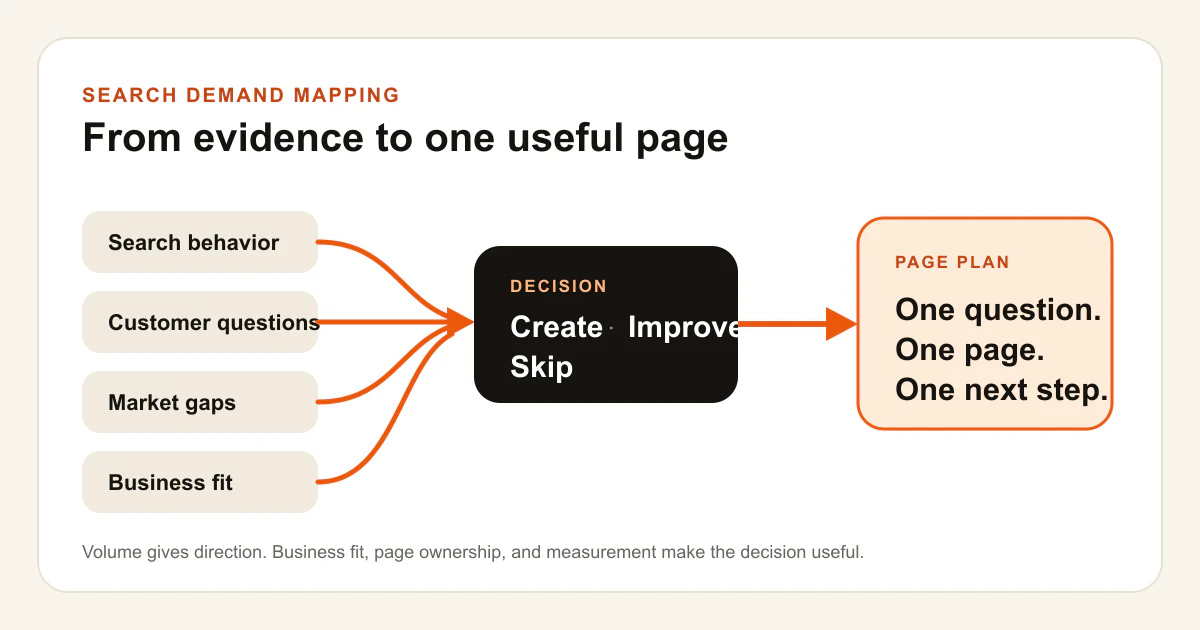
What should a search demand map decide?
A search demand map should decide whether to create a page, improve an existing page, or skip the idea. A keyword list alone cannot make that call.
Start with the customer. What are they trying to find, compare, avoid, or buy? Then check whether the business can answer that need with a real service, useful knowledge, or proof. The final page should have one main job and one clear next step.
Which evidence belongs in the demand map?
Use several kinds of evidence because each one answers a different question. Search data shows how people phrase a need and gives a directional view of demand. Live search results show what Google believes the query means now.
- Search evidence: query wording, related questions, estimated demand, and the current result page.
- Customer evidence: sales calls, reviews, emails, forms, and repeated objections.
- Market evidence: answers competitors provide well, gaps they leave open, and pages that already satisfy the intent.
- Business evidence: the offer, service area, capacity, expertise, economics, and proof the business can maintain.
- First-party evidence: Search Console, analytics, lead quality, and sales data once the business has enough clean history.
Estimated volume is direction, not a promise. A small query can still matter when it carries strong buying intent. A large query can be useless when it does not fit the offer.
How do you turn the evidence into one page?
Group phrases that represent the same decision under one page. Split them only when the customer needs a meaningfully different answer or action.
- Write the main question in the customer's words.
- Name the page that already owns the answer, if one exists.
- State the complete short answer the page must give near the top.
- List the supporting questions that help the reader make the same decision.
- Choose the service, guide, or action that should receive the next click.
- Add a relevant link into the page from an existing part of the site.
For example, a local SEO service page can explain the service. A local SEO cost guide can own price drivers. Putting both full arguments on both pages makes the site harder to understand.
When should you reject a page idea?
Reject the idea when it duplicates an existing page, does not fit a real offer, needs proof you do not have, or cannot earn a useful next step.
Also reject pages built only because a city, industry, or wording variation exists. A new URL needs a distinct reader need and enough true material to satisfy it. Changing the place name while repeating the same page is not a demand strategy.
If the idea is valid but the proof is not ready, keep it behind a human gate. Build the source packet first. The page can wait.
How do you measure whether the demand map worked?
Measure the page from discovery through business outcome. Search Console shows impressions, clicks, queries, and position in Google Search. Analytics shows what visitors do after they arrive.
Calls, forms, qualified leads, appointments, sales, and revenue are later steps. Keep them separate. A page can gain impressions without producing a lead, and a lead can arrive without becoming a customer.
Set the starting point before publication. Check that the page is live and discoverable first, then review the first useful window after enough time has passed. Google's own guidance says search changes can take from hours to several months, so one early check cannot prove the final result.
See how BlackTiger studies customer demand, then route the right opportunity into local visibility or a clear website page.
When the opportunity is valid but the business still sounds like every competitor, use the local-service positioning test to connect the message to one provable operational difference.
Common questions
Questions about Search Demand Mapping for Small Businesses
Is a keyword list the same as a demand map?
No. A keyword list records phrases. A demand map connects a customer need to business fit, one page owner, a useful next step, and a measurement plan.
Does every keyword need its own page?
No. Phrases that serve the same intent usually belong on one complete page. Create another URL only when the reader needs a different answer or action.
Can low-volume searches still be valuable?
Yes. A narrow search can carry strong buying intent or match a profitable service. Volume is one input, not the final decision.
When should a business update the map?
Review it when the offer, market, search results, or first-party data changes. A quarterly remap is useful for an active program, with earlier reviews when a major signal moves.
Sources and limits
Primary guidance and first-party boundaries.
- Google SEO Starter GuideGoogle's current guidance on discovery, site organization, links, and the time needed to assess search changes.
- Google Search Console and Analytics guideDefines Search Console as the search-performance source and Analytics as the on-site behavior source.
- BlackTiger demand research serviceThe commercial owner for research, prioritization, and the next business decision.
Map the demand before you build against it.
Tell us what you sell and where you want to grow. We will show you which customer questions deserve a page and which ones do not.